
By Arie Egozi, Autonomy Global Ambassador – Israel
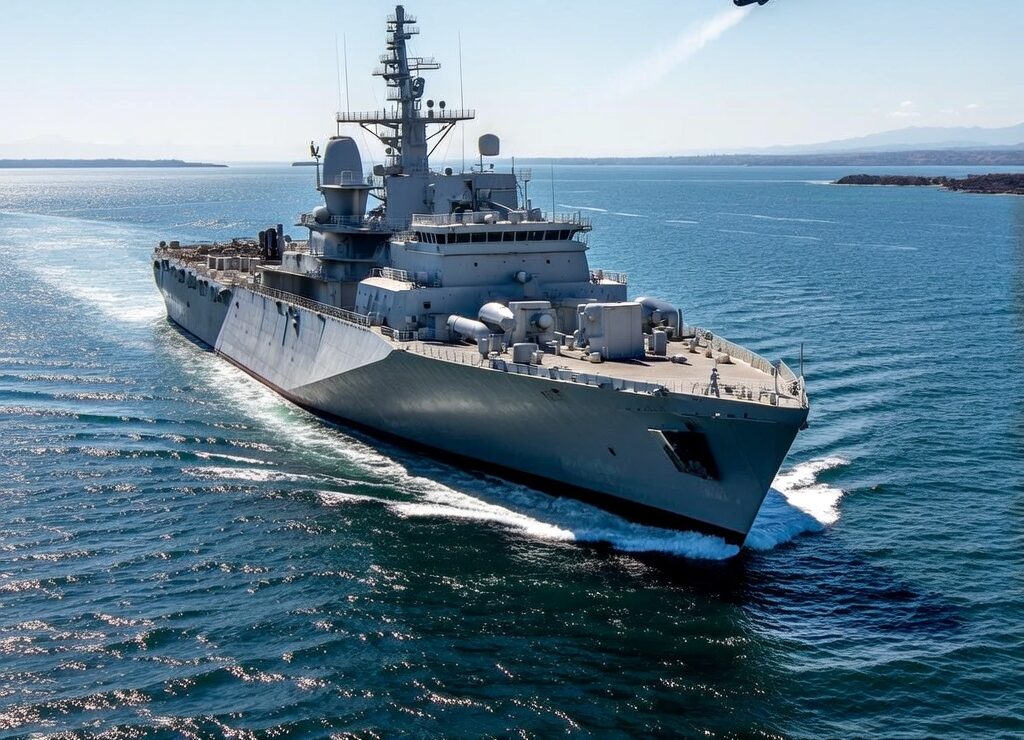
The U.S. Navy has made its foray into use of low-cost, one-way attack drones with the first at-sea launch of a Low-cost Unmanned Combat Attack System (LUCAS) from a warship in the Middle East. On 16 December 2025, the Independence-class littoral combat ship USS Santa Barbara (LCS 32) launched a LUCAS drone from its flight deck while transiting the Arabian Gulf. This marks a significant milestone for the U.S. Naval Forces Central Command (NAVCENT) and U.S. 5th Fleet.
LUCAS Launch in Arabian Gulf
Task Force 59, NAVCENT’s unmanned and autonomous operations group, conducted the launch from the USS Santa Barbara, using a LUCAS airframe assigned to the newly formed Task Force Scorpion Strike. Vice Adm. Curt Renshaw, commander of NAVCENT/5th Fleet, described the event as a “significant milestone” in rapidly delivering affordable unmanned capabilities that enhance regional maritime security and deterrence in critical chokepoints such as the Strait of Hormuz.
Low-Cost Attack Drone Trend
Israeli defense analyst Tal Inbar told Autonomy Global that the U.S. has now clearly joined the trend pioneered by Iran, Russia and Ukraine of fielding low-cost attack drones at scale, while still paying more per unit than Tehran and Moscow for comparable platforms. According to Inbar, this reflects a deliberate policy shift in which Washington is embracing expendable, mass-produced systems instead of relying solely on expensive cruise missiles and legacy precision weapons.
Shahed-Inspired Design with U.S. Upgrades
LUCAS is widely reported to be reverse-engineered from captured Iranian Shahed-136 “kamikaze” drones. The drone mirrors the Shahed’s delta-wing layout and pusher-prop configuration but with added U.S. upgrades. These U.S. enhancements reportedly include greater range, improved autonomy and mesh-networking features that enable coordinated swarm attacks and distributed targeting across a wide battlespace.
Flexible Launch and Mass-Production
LUCAS is designed for flexible launch profiles, including ship-based operations, catapults, rocket-assisted takeoff and mobile ground or vehicle-mounted systems for rapid deployment from austere or improvised sites. With an estimated unit cost of about 35,000 dollars, the system is optimized for mass production by multiple U.S. manufacturers. This provides commanders with a scalable strike option that can be treated more like expendable munitions than high-end missiles.
Task Force Scorpion Strike and Regional Focus
In late 2025, U.S. Central Command stood up Task Force Scorpion Strike, the first dedicated one-way attack drone squadron, to operate LUCAS across the CENTCOM theater under Special Operations Command Central oversight. (See prior AG news coverage of TF Scorpion Strike). The initial LUCAS deployments in the Middle East aim to counter Iran-backed forces and signal that Washington is prepared to match and overmatch the Shahed-style drone arsenals that have reshaped recent conflicts in Ukraine and across the region.